Documentary
Rope on film: what the camera adds and what it destroys
By Yuki Almeida, Tradition and aesthetics Published 26 August 2026 Revised 26 August 2026
Filmed rope falls into three forms. The shibari documentary records a practice and the people who carry it. The recorded performance transfers a stage piece to a lens. Art cinema borrows rope as composition inside a story it is telling for other reasons. Each form gains duration and motion, and each loses the one decisive frame a photograph gets to keep. Most of them come apart on pacing, because rope is slow and editing is impatient. This page describes those categories rather than a canon, because no agreed canon exists.
- Work
- Rope on film
- Director
- Various
- Year
- 1970s to present
- Kind
- Documentary
This site writes about rope as an image, and it publishes no tying instructions: no steps, no named ties given as method, nothing to follow. Rope on a body carries real physical risk, and anyone who wants to learn it should learn in person, slowly, from experienced teachers.
Rope holds still. Film does not. Nearly everything that goes wrong when a camera is pointed at a rope scene follows from that single mismatch, and nearly everything that goes right is somebody’s solution to it.
This page is a survey of forms, not a list of titles. There is no settled canon in this corner, no set of films a reader can be sent to with any confidence, and assembling a fake one would be worse than admitting the gap. What follows describes the kinds of film that exist, what each kind is trying to do, and how a good one differs from a merely competent one.
Three forms, and the different jobs they take on
Documentary treats the practice and its practitioners as the subject. Its natural material is talk, preparation, the room before and after, and it succeeds or fails on whether the people in it are allowed to be specific rather than representative. The recurring weakness of the form is explanation: a documentary that spends its running time telling a general audience what rope is has no time left to show anyone doing anything.
Recorded performance is a transfer rather than a film. A piece was made for a live room, and a camera is placed in that room to carry it somewhere else. Almost every decision here is a loss calculation, which is why it deserves its own page.
Art cinema is the third case and the least concerned with rope as a topic. A director uses a bound figure for the shape it makes in the frame, for the way it fixes a body in a composition, for what stillness does to a scene’s rhythm. The rope is a formal device inside a story about something else, and that distance is exactly what makes the art film use of it interesting to look at.
A fourth category exists and is by far the largest: commercial adult production. It is filmed rope by volume and it operates by entirely different rules. This site does not survey it.
What motion adds
A photograph gets one moment and asks the viewer to invent everything around it. Film has the opposite deal. It can show the approach, the small adjustment, the pause where nobody is doing anything visible, the shift in attention that a still image can only imply, and the coming down afterwards. That last passage is the one almost every photographic tradition leaves out, and it is often where the interesting material is.
Film can also show weight arriving. A great deal of what a rope image is about is load transferring from a body to a line, and in a still frame that has either happened or it has not. On film it happens in front of you, over seconds, with the small negotiations that go with it. No photograph does that.
What the recording quietly removes
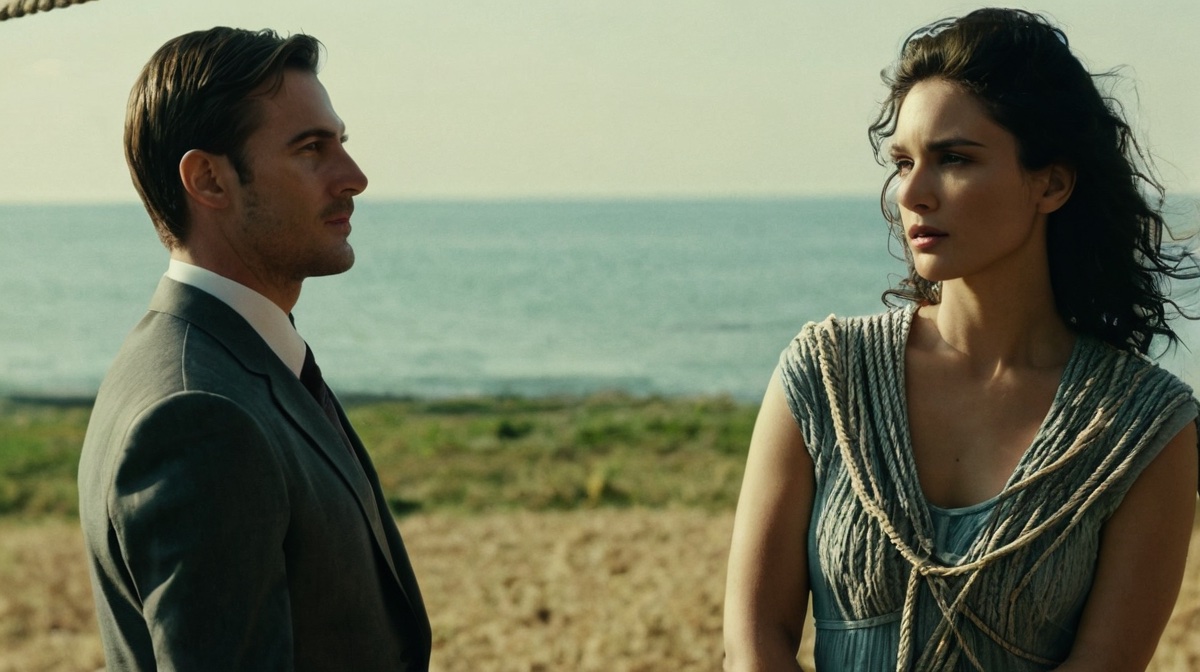
The lens takes away scale first. A room communicates the size of a body and the height of a suspension point through peripheral vision, and a frame with edges gives none of that back. Everything looks nearer and smaller than it was.
It takes away sound in a way people underestimate. In the room there is breathing, the specific creak of loaded fibre, the noise the floor makes. A recording flattens all of it under whatever the camera’s microphone happened to catch, usually the air conditioning.
Most of all it takes away where you were looking. A live audience distributes attention: a person watches the hands, then the face, then the whole shape, then drifts. A recording makes those decisions for you and hides the fact that it did. The framing is an argument, and it is one the viewer cannot see being made.
Pacing is where most of them fail
Rope runs on its own clock, and it is slower than any other clock in film. An editor trained on any other subject reaches for the cut, because the material contains long passages where nothing that looks like action is happening. Remove those and the piece becomes a sequence of arrivals with no journeys, which is precisely the accusation that gets made about most rope video: it looks like a slideshow with movement.
The opposite failure is more sympathetic and just as fatal. Leave everything in, hold every shot, refuse to cut, and you get forty minutes that only the people who were present can sit through. Duration is not automatically meaning.
The films that work treat slowness as content and structure it anyway. They cut, but on breath and attention rather than on action. They allow one long take to earn its length by putting something in it that develops. They understand that the audience is watching a face at least as much as a body, which is the same lesson the still photographers learned and which the craft of lighting rope keeps running into from the other direction.
Watching one properly
Ask what the camera decided. Ask what it refused to show and whether the refusal was a choice or an accident. Ask whether the people on screen were given the dignity of being specific. Those questions work on a documentary, a recorded performance and a feature alike, and they are the same questions a good still image has to answer in one frame instead of a thousand.
Questions readers ask
Is there a canon of films about shibari?
No, and anyone presenting one should be read carefully. Filmed rope is scattered across documentary, recorded performance, art cinema and a very large commercial adult industry, with no shared distribution, no critical apparatus and very little writing that treats the material as film rather than as content. What exists is a set of recurring forms, which is what this page describes.
What can film show about rope that a photograph cannot?
Duration, and therefore consequence. A photograph holds one instant and asks the viewer to supply everything around it. Film shows the approach, the adjustment, the pause, the moment attention shifts, and the coming down afterwards, which is the part almost every still image leaves out. The cost is that film almost never contains a frame as good as a good photograph.
Why do recordings of rope so often feel flat?
Usually pacing, sometimes light. A camera cuts on action, and this subject has very little action to cut on, so an editor either chops the slow passages that carried the meaning or leaves everything in and produces something unwatchable. Stage lighting built for a live audience compounds it, since a lens has a fraction of the tolerance an eye has.
Footage is the residue of a room
Someone booked the space, agreed the terms and turned the lights down. None of that is on the recording, and none of it happens on a screen.
Find the people