Recorded performance
Filming a rope performance without killing it
By Perrine Vaux, Performance writer Published 16 August 2026 Revised 16 August 2026
A rope performance video is a transfer rather than a film, and every decision in it is a loss calculation. A single locked camera keeps the piece honest and the geography intact but records the stage rather than the performance. Multiple cameras recover intimacy and cost continuity, since cutting between angles imposes a rhythm the piece never had. Stage lighting is built for an eye with far more tolerance than a sensor, so the contrast that reads beautifully from row six usually arrives as black holes and blown highlights. What no format recovers is scale, room sound and the audience deciding where to look.
- Work
- Recorded performance
- Director
- Various
- Year
- 2000s to present
- Kind
- Recorded performance
This site writes about rope as an image, and it publishes no tying instructions: no steps, no named ties given as method, nothing to follow. Rope on a body carries real physical risk, and anyone who wants to learn it should learn in person, slowly, from experienced teachers.
A rope performance video is not a film about a performance. It is an attempt to move an event out of the room it was made for, and every choice in it is a decision about what to lose.
Performers who understand this shoot differently. They stop asking how to capture the piece and start asking which version of it the recording is going to be, which is a question with an answer. The form has less in common with documentary than people assume, and almost nothing in common with the way art cinema frames a bound figure, where the camera was there from the first rehearsal and the audience was never in the room at all.
One camera, or three
The single locked wide camera is the honest default. It sits where a good seat would be, it runs from the first cue to the last, and it does not lie. Geography stays intact: a viewer can see where the rig is, where the performers are relative to it, how far someone travelled. Continuity is guaranteed because there is nothing to cut. What it records is the stage rather than the performance, and faces are small.
Three cameras recover what the wide loses and introduce a new problem. Once there are angles, someone has to choose between them, and every choice imposes a rhythm the live piece never had. An audience in the room decides for itself when to look at a face; an edit decides for everyone and does it at a tempo borrowed from other kinds of film. Multi-camera recordings are more watchable and less trustworthy, and both halves of that are true at once.
The working compromise is well established. Run the locked wide for the whole duration as a spine that can never fail, add one operated camera for closer material, and cut into it sparingly. The wide is the document. The second camera is the commentary.
Stage light against the lens
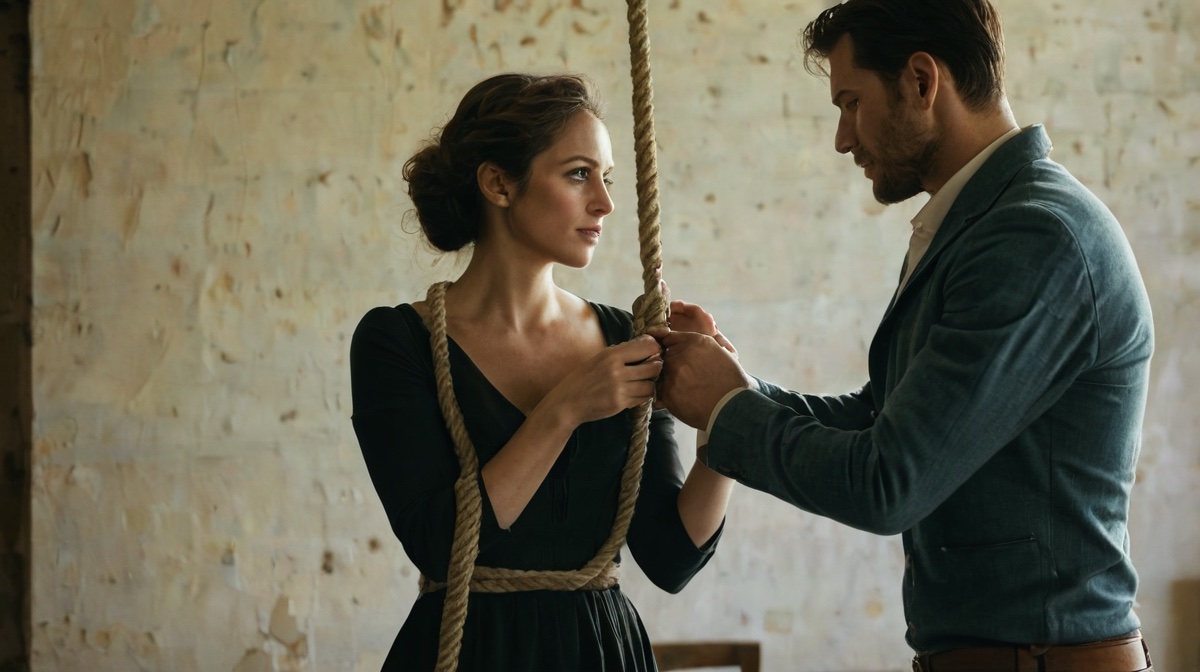
Stage lighting is designed for an organ that adapts constantly and tolerates an enormous range of brightness. A sensor does neither. It holds one exposure, and beyond a certain distance from that exposure it simply stops recording information.
This is why the lighting state that looks magnificent from row six turns up on the recording as a body cut in half, one side black and featureless, the other side white with no texture left in it. Rope makes this worse than most subjects, because fibre reads through the fine shadow along its own twist. Lose that and the rope becomes a flat grey cord, which is roughly the difference between a picture of rope and a picture of a line. The same physics governs the studio, and lighting rope for photography treats it in detail.
Productions that record well light twice. There is a state for the room and a modified state for the camera, and the difference is negotiated before the doors open rather than discovered in the edit. Sometimes that means raising the fill by an amount the live audience will never notice and the recording depends on entirely.
What the room had and the file does not
Scale goes first. Height is felt in a room through peripheral vision and the position of the ceiling, and a frame with hard edges supplies none of that. Rigs that dominated a space photograph as ordinary furniture.
Sound goes second, and the loss is larger than people expect. A live piece has breathing in it, the particular noise loaded fibre makes, the sound of a floor. An on-camera microphone gathers the room’s air handling and a cough from the third row, then compresses the rest into background. Recordings that keep their charge almost always had a separate audio plan.
Attention goes third and matters most. In the room, watching is an activity: a person chooses the hands, then the face, then the whole shape, then lets the mind wander and comes back. A recording removes that entirely. The viewer receives someone else’s attention, already spent. This is the same shift that happens between a live scene and a still photograph of one, and it is why the collaboration behind an image has a fourth party once a camera is present.
The edit as a second performance
Performers who record often start writing for the edit, and the honest ones say so. A piece intended to be recorded can hold a shape longer than a live piece needs to, because the camera will use the extra seconds. It can place its strongest moment where a cut can reach it. It can be structured in blocks that survive being reordered.
None of this is dishonest, but it is a different work. The live version and the recorded version become two pieces sharing a set of materials, and the audience for each gets something the other does not. Trouble arrives when a performer pretends otherwise and presents the recording as the piece, complete, with nothing lost.
The better position is the modest one. A recording is a good document, a fair argument and a poor substitute. It sits in the same relationship to the evening that a photograph does, which is the relationship the whole of filmed rope has to live practice, and it holds up best when it stops pretending to be the thing itself.
Questions readers ask
One camera or several for a rope performance?
One locked wide camera is the honest default: it preserves the geography of the stage, never lies about continuity, and produces a document rather than an interpretation. Multiple cameras give a viewer the face and the detail that the wide shot loses, at the cost of imposing an edit rhythm the live piece never had. The common compromise is a locked wide running the whole piece as the spine, with one operated camera supplying inserts.
Why does stage lighting look wrong on camera?
An eye handles a far wider range of brightness than a sensor does, and it adapts continuously while a camera holds one exposure. Lighting designed to look dramatic to a live audience routinely arrives on a recording as crushed black on one side of a body and blown white on the other. Recordings that hold up were usually lit twice: once for the room, once for the lens, with the compromise agreed in advance.
What does a recording lose from a live rope performance?
Scale, sound and choice. The frame removes peripheral vision, so the height of a rig and the size of a body stop registering. Room sound goes under the microphone. And the audience loses the freedom to look where it wants, because the camera has already chosen, which converts an open experience into an argued one.
Footage is the residue of a room
Someone booked the space, agreed the terms and turned the lights down. None of that is on the recording, and none of it happens on a screen.
Find the people