Feature and art cinema
Rope in art cinema: composition, not spectacle
By Yuki Almeida, Tradition and aesthetics Published 26 August 2026 Revised 26 August 2026
Bondage in art film behaves differently from bondage in genre film, because the director is using it for shape rather than for shock. A bound figure fixes a body at a known point in the frame, which lets a composition be built around it the way a painter builds around a seated sitter. It removes the actor as a moving element, so duration becomes visible and the camera can hold. And it converts blocking, the business of who stands where, into something the audience reads as meaning. This page describes those conventions rather than cataloguing films, because a survey assembled from half remembered scenes would be worthless.
- Work
- Rope in art cinema
- Director
- Various
- Year
- 1960s to present
- Kind
- Feature and art cinema
This site writes about rope as an image, and it publishes no tying instructions: no steps, no named ties given as method, nothing to follow. Rope on a body carries real physical risk, and anyone who wants to learn it should learn in person, slowly, from experienced teachers.
Genre film uses restraint as an announcement. Something has happened, the image tells you so, and the story moves. Art cinema tends to use it as a condition, and the difference is visible in the length of the shot before anything else.
That distinction is a formal one rather than a moral one. A serious director reaching for a bound figure is usually reaching for a compositional device, and the device does three specific things.
A body that will stay where it is put
Painters have always had an advantage over directors: the sitter holds the pose. Cinema gave that up in exchange for movement and has been inventing ways to get it back ever since, through the locked frame, the tableau, the actor instructed not to move.
A restrained figure is the strongest version of that recovery. The body occupies a known point and will occupy it for the length of the shot, so everything else in the frame can be arranged in relation to it: the light, the furniture, the second actor, the empty space. The composition becomes stable enough to be built rather than caught, which is the condition still photographers work in as a matter of course and which the aesthetics of a rope image assume from the outset.
The effect is easiest to see in the negative. Watch how quickly a scene loses its shape once the figure is released and free to walk about. The frame goes from architecture to reportage in a single move.
Duration becomes something you can see
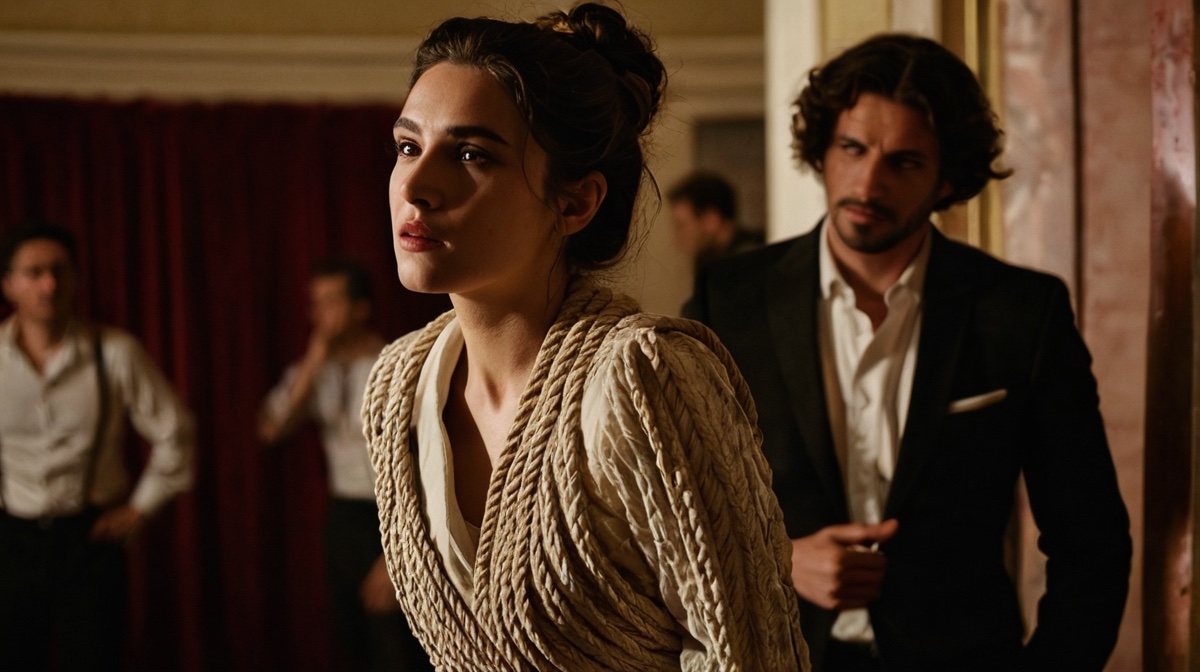
Time in a film is normally carried by change. Someone crosses a room, a car arrives, a face turns. Remove the movement and duration has nothing to hide behind, so the audience begins to feel the seconds directly.
Directors who understand this hold the shot past the point of comfort deliberately. The image stops describing a situation and starts describing a length of time, and the viewer’s attention, having nothing to track, turns inward or turns to the face. It is the same manoeuvre a long static shot of a landscape makes, with a person in the middle of it.
Genre editing does the opposite by reflex, cutting away as soon as the point lands. That single decision, cut early or hold, separates most of what gets called art cinema in this area from most of what does not, more reliably than subject matter ever will.
Restraint as blocking
Blocking is the arrangement of bodies in a space and the rules governing which of them may move. Audiences read it without being taught, which is why theatre directors treat it as a language.
Rope makes the language explicit. One figure can move and one cannot, and everything that follows in the scene is coloured by that asymmetry, including dialogue that never mentions it. A director gets a power relation installed in the geometry of the shot at no narrative cost, and can then spend the scene complicating it. Some of the more interesting uses run the meaning backwards, giving the still figure the authority and the moving one the anxiety.
Why this page names almost nothing
One title comes up more than any other whenever this subject is raised in English, and it is fair to name it. Nagisa Oshima’s In the Realm of the Senses, released in 1976, was a Japanese and French co-production finished in France, and it has been discussed for decades at least as much for the censorship history around it as for anything inside the frame. Its Japanese release was censored, which is a matter of record.
This page will not describe its contents, and it will not assemble a list of companions for it. Writing about films from memory is how invented scenes enter circulation, and rope already carries more fabricated history than any small subject should have to. A survey that names ten titles and gets two of them wrong is worse than useless, because the two errors will be repeated by everyone who trusts the other eight.
What can be described honestly is the grammar, and the grammar is transferable. It also runs both ways: the still image borrowed from cinema at least as often as cinema borrowed from photography, and the photographers surveyed in the makers section worked with the same instincts about held time and fixed position. The plates on this site are made under exactly these constraints, and the wider question of what a lens does to this subject is taken up in the survey of rope on film.
Questions readers ask
What does art cinema use rope for?
Formally, for three things. It fixes a figure at a determined position so a composition can be built around it. It removes the actor as a source of movement, which makes the passage of time in a shot visible. And it turns blocking into legible meaning, since the geometry of who can move and who cannot is instantly readable. Whether the film is about restraint at all is a separate question, and often the answer is no.
How is this different from bondage in genre film?
Genre film generally uses restraint as an event: something has happened, and the image announces it. Art cinema is more likely to use it as a state, holding on it long enough that the audience stops reading the situation and starts reading the picture. The difference shows in shot length and camera movement more reliably than in anything on screen.
Why does this page name so few films?
Because accuracy costs more than coverage. Writing about films from memory produces confident sentences about scenes that do not exist, and this subject already carries more invented history than it can hold. Describing the conventions is honest and useful. A canon assembled to look authoritative is neither.
Footage is the residue of a room
Someone booked the space, agreed the terms and turned the lights down. None of that is on the recording, and none of it happens on a screen.
Find the people