Aesthetics
What makes a rope image beautiful
By Yuki Almeida, Tradition and aesthetics Published 22 July 2026
A rope image is judged on asymmetry, on whether a single line can be seen taking the load, on how much of the frame it leaves empty, on the contrast between fibre and skin and cloth, and on its refusal to show the obvious peak of the action. Those are formal preferences and they can be described in plain terms. The Japanese aesthetic vocabulary that gets attached to them, ma and wabi-sabi in particular, is usually applied loosely and explains less than it appears to.
This site writes about rope as an image, and it publishes no tying instructions: no steps, no named ties given as method, nothing to follow. Rope on a body carries real physical risk, and anyone who wants to learn it should learn in person, slowly, from experienced teachers.
Ask why a rope photograph is good and the answers usually come back technical: the light, the composition, the model. Those are means. The values underneath them are narrow, consistent, and easy to state.
Symmetry is the first thing to lose
Put a figure square to the camera, arms matched, rope mirrored left and right, and the picture closes. There is nothing to follow, because both sides say the same thing. The eye arrives, confirms the arrangement and departs.
Almost every rope image that works is off balance in some way. One shoulder is higher. The weight has gone onto one hip. A line runs diagonally across the frame instead of level with its edges. That imbalance sets up a direction, and direction is what gives the eye somewhere to travel. Even in a static pose, an asymmetric arrangement suggests that something is being resisted, and the suggestion of resistance does more work than any amount of visible strain.
One line should be doing the work
The single most common feature of a strong rope picture is that a viewer can find the line carrying the load and follow it. Everything else can be decorative. One thing has to be structural, and the picture is better when the structure is legible.
This is why intricate work often photographs badly. A dense arrangement gives the eye twenty candidate lines and no way to rank them, and the result reads as pattern rather than as tension. A picture built around one taut line and a body arranged in response to it reads instantly, even at thumbnail size. Complexity impresses in the room. Clarity survives the camera.
The empty part of the frame
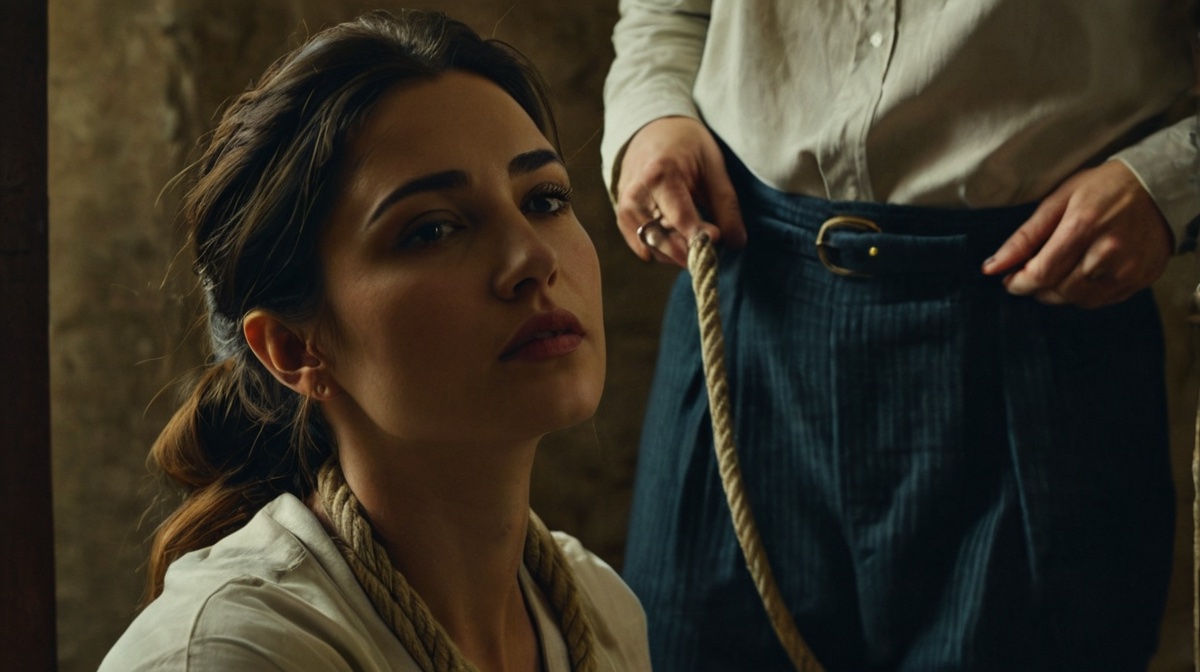
Look at rope images that have lasted and count how much of each frame contains nothing. It is usually most of it. A figure occupies a third, the light describes a small region, and the remainder is dark or blank ground.
Empty space does two things at once. It isolates the subject, so the eye has no competing detail to settle on. And it implies a room the picture has chosen not to show, which puts the viewer just outside something rather than inside it. Filling the frame removes both effects. This is the value most often lost when a photographer moves from a controlled setup to a real location, because a real location offers furniture, and furniture is very hard to leave out.
Fibre against skin and cloth
Rope is interesting to look at because it is made of twisted fibre, and twisted fibre catches light in bands. Against skin, which is smooth and reflects softly, that banding reads as an obvious material difference: two surfaces the eye can tell apart without any conscious effort.
The best of these pictures set up a third texture as well. A folded cotton robe, a length of silk, a woven mat. Three surfaces, each handling light differently, give a monochrome image something to be about even before the arrangement is considered. Photographers who understand this treat the fabric as seriously as the rope, and lighting rope for photography covers what happens when the light chosen refuses to separate any of them.
The moment beside the moment
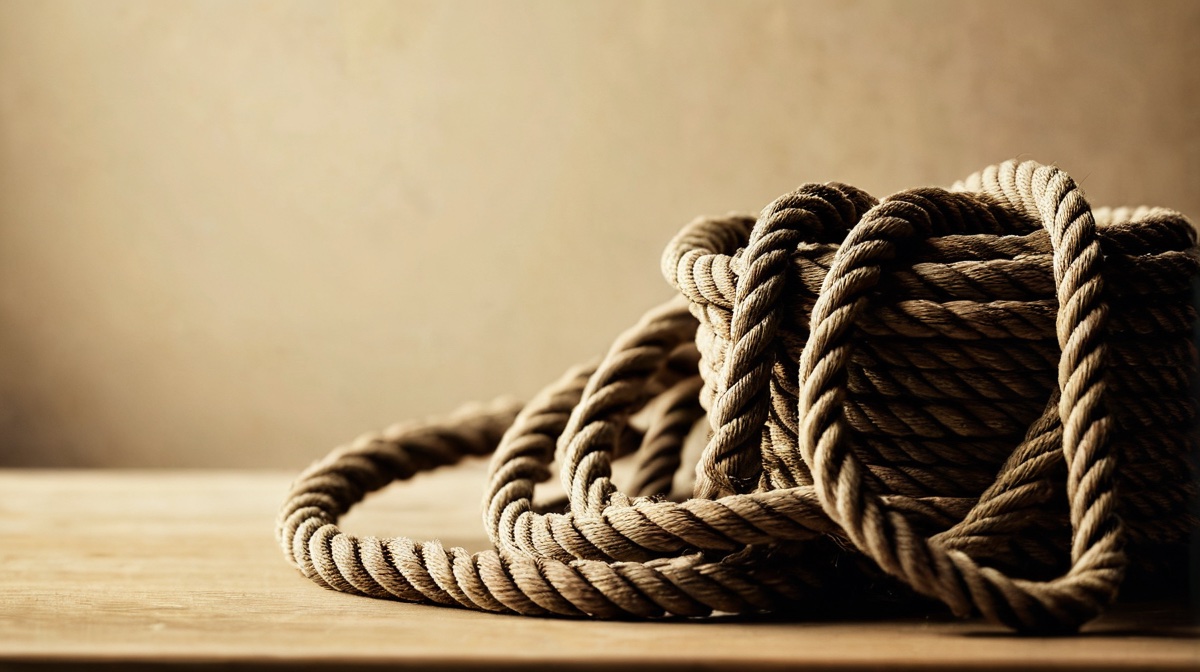
The tradition consistently prefers the instant on either side of the obvious one. A hand about to make contact. A held breath. A figure sitting on the floor afterwards with the rope loose in a heap.
There is a practical reason and an aesthetic one. Practically, the peak of anything tends to look like effort, and effort photographs as strain rather than as intent. Aesthetically, an unfinished action recruits the viewer, who has to complete it. A completed action leaves nothing to do. The same preference governs faces: eyes closed or turned away hold attention longer than eyes meeting the lens, because a look into the camera settles the question of who the picture is for.
Borrowed words, handled carefully
English writing on this subject reaches quickly for Japanese aesthetic vocabulary, and the reaching should be done with more care than it usually gets.
Ma, the interval or charged gap, has genuine descriptive value here. The empty portion of a rope image really does behave like an active element rather than leftover background, and there is no equally compact English word for that. Using ma to name the effect is defensible.
Wabi-sabi is invoked far more often than it earns. It belongs to a long tradition concerned with impermanence and the beauty of the imperfect, and it gets applied to any rope photograph that is dim, grainy or slightly out of focus. Most of those pictures are not austere. They are underexposed. Borrowing the word does not make the picture better and it does the original concept no favours.
The safer approach is to describe what is in front of you in plain terms and reach for the borrowed word only when the plain terms run out. That happens less often than the writing on this subject suggests. Where the terms came from and how much of the surrounding history is reliable is the subject of from hojojutsu to kinbaku, and the same caution applies to both.
Questions readers ask
Why do rope images avoid symmetry?
A symmetrical arrangement resolves itself. The eye reads it in one movement, finds both halves equivalent and has nowhere further to go. Asymmetry keeps a picture unfinished for a few seconds longer, which is most of what holding attention means. It also produces a diagonal, and a diagonal implies weight moving somewhere, which a level horizontal never does.
Is it accurate to explain kinbaku aesthetics using ma and wabi-sabi?
Only loosely, and the looseness should be admitted. Both terms come from long traditions with their own contexts, and neither was formulated with rope photography in mind. Ma, the charged interval, does describe something real about how these pictures use empty space. Wabi-sabi is invoked far more often than it earns, usually to dignify a picture that is simply underlit. Plain description is safer and generally sharper.
Why do so many rope photographs show a moment before or after rather than the peak?
A picture of a peak has told the viewer everything at once and leaves nothing to infer. The instant before carries expectation and the instant after carries consequence, and both require the viewer to supply the missing part. That supplying is the experience. It is the same reason a face turned slightly away tends to hold attention longer than one looking straight at the lens.
History is a record of people who met
Every tradition on this page was carried by practitioners who found each other, argued, and worked. Reading about it is the smaller half.
Find the people