Staging
Wardrobe and drapery
By Perrine Vaux, Performance writer Published 14 September 2026
Cloth is the third texture in a rope photograph and the most controllable one. It supplies a tone the photographer can choose, which is the fastest way to solve the dark-on-dark problem. It gives the frame a surface that folds, so light has something to describe besides skin and fibre. And it decides how much of the picture is about the body at all. The consistent finding is that plain heavy fabric in a chosen tone outperforms anything designed to look like a costume, because a costume tells the viewer what kind of picture they are looking at and then the picture has to live up to it.
This site writes about rope as an image, and it publishes no tying instructions: no steps, no named ties given as method, nothing to follow. Rope on a body carries real physical risk, and anyone who wants to learn it should learn in person, slowly, from experienced teachers.
Wardrobe on a rope shoot tends to be settled in the last five minutes, from what somebody brought. It is worth moving to the front, because cloth is the only material in the frame whose tone, texture and quantity the photographer gets to choose outright.
Three surfaces, not two
Skin is smooth and returns light softly across a broad area. Rope is fibrous and returns it in bands. Those are two ways of handling light, and a frame containing only those two has a narrow palette to work with.
Cloth is a third way. It folds, so it generates its own shadows independent of anything the lighting is doing. It can be matte or slightly lustrous. And it can be any brightness at all, because it is chosen rather than given.
That third surface is what makes a monochrome frame worth looking at before the arrangement is even considered. The images from this tradition that hold up over time nearly all have it: a folded robe, a length of silk, a woven mat. Two materials is a document. Three is a picture.
Cloth is the fastest fix for the tone problem
Everything sitting in one narrow band of tone, dark rope on dark ground in dark clothing, is the commonest failure in rope photography. There are several ways out and wardrobe is the cheapest.
A pale robe against dark jute establishes the tonal separation the composition needs, in a form that can be positioned anywhere in the frame and rearranged between frames. It does not require moving a light, changing a background or repositioning anybody.
It also solves the specific collision between fresh jute and pale skin, which sit close together in both hue and brightness. Put a mid or pale cloth between them and the eye has a reference point that tells the two warm surfaces apart. The other approaches to that collision are in photographing the texture of jute, and none of them is as quick.
Weight beats style
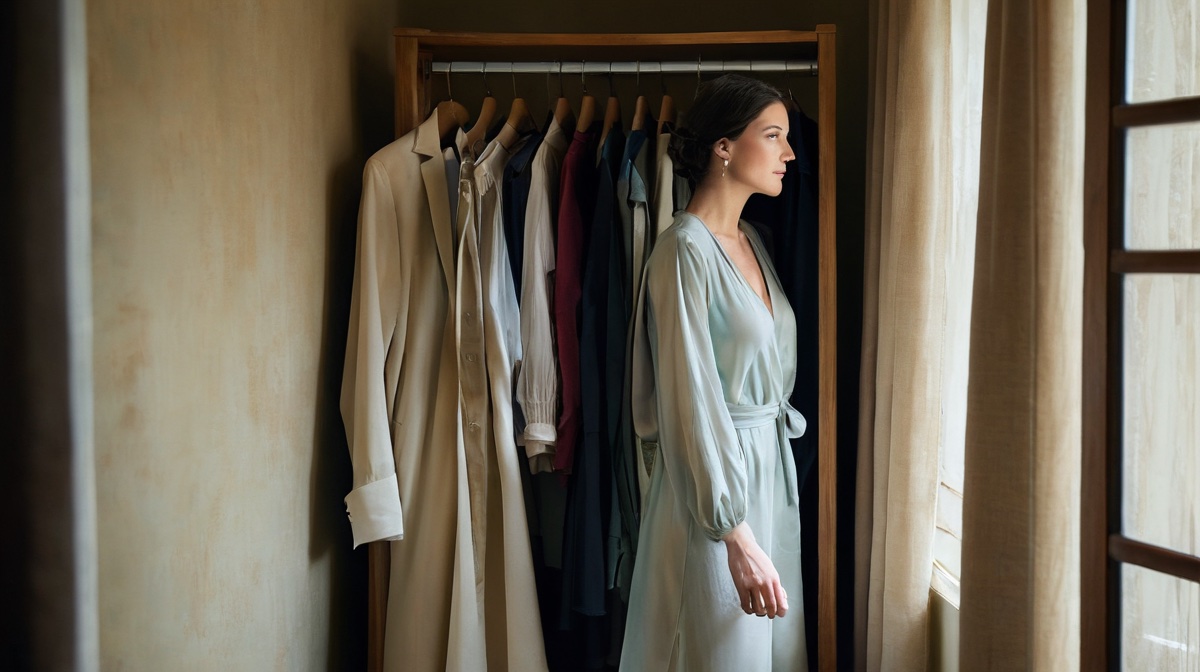
What matters in a fabric is not what it is called. It is whether it holds a fold.
Heavy cotton, linen, thick silk and wool all fold into shapes that stay put and cast their own shadows. A fold is a small piece of geometry the photographer did not have to build, and a good one will do as much for the frame as a considered light. Light synthetics do not fold, they cling and crease, and creases read as untidiness rather than as form.
Length matters for the same reason. A short garment gives you an edge. A long one gives you a pool of fabric on the floor, which is a compositional element in its own right and one of the most useful things available for filling the bottom of a vertical frame.
Why the robe keeps winning
Across a century of this material, the same garment keeps appearing: a simple wrapped robe in a plain colour. It is not nostalgia, or not only nostalgia.
A robe opens. It can be closed, half open or off one shoulder, which gives a continuous range between covered and uncovered without any change of costume, and the intermediate positions are the ones that produce the strongest pictures. It also creates a strong diagonal edge across the torso that the composition can use or work against.
It is also unspecific. A robe does not announce a decade, a subculture or a price bracket, so the picture can be about what is happening rather than about who these people are. Anything with a recognisable cut or a visible brand does the opposite, and the viewer will spend their first second reading the clothes.
What a costume costs
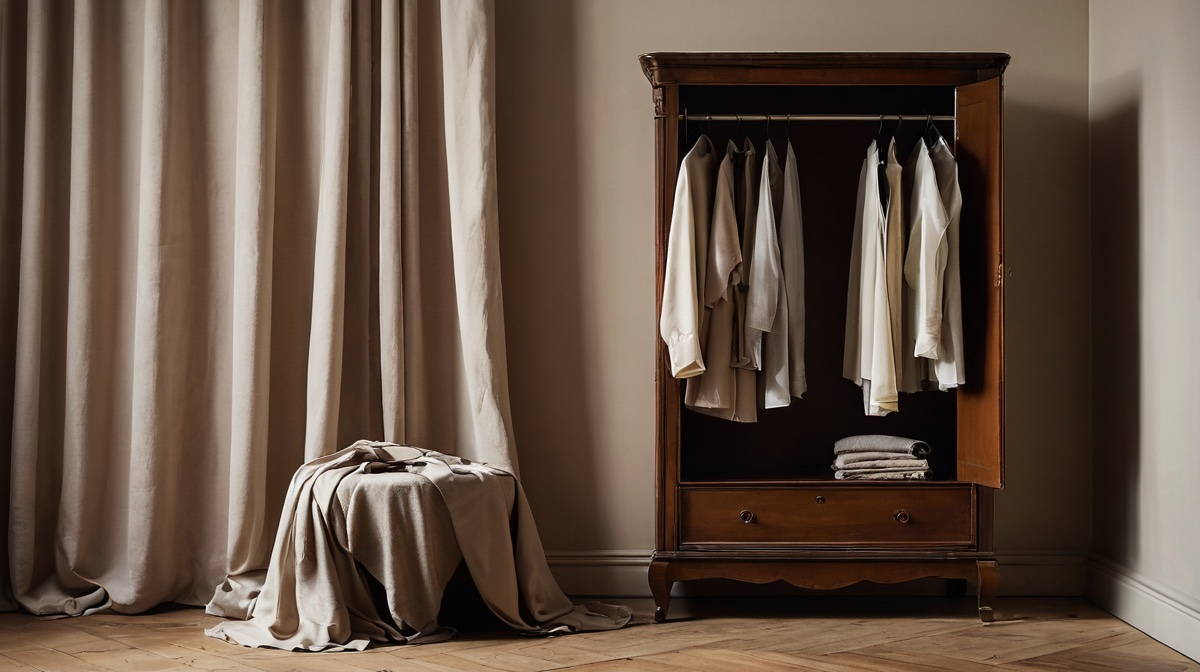
There is a version of this work that reaches for the full outfit: the period kimono, the corset, the uniform. It can be done well and it is usually done badly, for a reason worth naming.
A costume makes a claim. It says this is a picture of a particular kind of thing, and having made that claim the picture has to be good enough to sustain it. A partial or careless costume is worse than none, because the viewer notices the gap between what was attempted and what was achieved.
There is a second problem specific to this material. Elaborate dress competes with rope for the eye’s attention, and rope needs a plain surface to be read against. A patterned kimono and a jute line are two complex textures in the same frame, and the picture will not decide which one it is about.
Where cultural dress is involved there is a third consideration, which is whether the reference is being handled with any care or simply used for atmosphere. The same caution applies as with borrowed aesthetic vocabulary: borrowing is defensible when it is deliberate and knowing, and it looks cheap when it is decorative.
Decide it with the background
Wardrobe and background are one decision, not two, because they occupy the same tonal argument. A pale robe against a pale wall achieves nothing. A pale robe against a dark ground carries the picture.
Fix the ground first, since it is the largest area and the hardest to change once the session is running, then choose fabric that separates from it, then let the rope fall where it falls between them. That sequence is the practical companion to the ground behind the figure, and doing it in the other order means discovering at frame forty that the only robe in the room disappears into the wall.
The plate lantern and shoulder is a study in exactly this economy: one lit shoulder, one paper lantern, and the rest of the figure held in unmodelled shade by what it is wearing. The wardrobe there is doing as much structural work as the light.
Questions readers ask
What should a model wear for a rope photograph?
Something plain, in a tone that separates from the rope, made of a fabric heavy enough to hold a fold. A cotton or linen robe, a length of undyed cloth, a simple slip. The purpose of wardrobe here is compositional: it provides the third texture and the tonal anchor. Anything with a pattern, a logo, a fashionable cut or an obvious period will pull the picture towards being about clothes.
Why does drapery matter so much in this genre?
Because two materials are not enough. Skin is smooth and rope is fibrous, and a frame containing only those two has a limited tonal and textural range. Cloth adds a third surface that handles light differently again, folds into its own shadows, and can be placed at whatever brightness the composition needs. It is the element that turns a two-tone image into a composition.
Is partial clothing better than none?
For picture-making purposes it usually is, and not for reasons of modesty. Fabric gives the eye somewhere to go besides the body, it hides transitions the composition does not need, and it creates edges that the light can catch. A frame that is entirely skin and rope has to be carried by the arrangement alone, which is a much harder photograph to make and is rarely made well.
A shoot is three people and a lot of talking
Technique is the cheap part of an image like this. The collaborators are the expensive part, and they are found in rooms, not in tutorials.
Find the people