Staging
The ground behind the figure
By Perrine Vaux, Performance writer Published 27 August 2026
The background occupies most of a rope photograph and is usually the only part nobody planned. Three of them reliably fail: a dark ground behind dark rope, because the subject and the setting share one band of tone; a domestic room left as it was found, because it supplies horizontal lines and objects that compete for attention; and a wrinkled paper backdrop lit flat, because it announces a studio without providing one. The preparation is subtractive. Decide what the frame contains, remove everything else, and do it before anyone is in position.
This site writes about rope as an image, and it publishes no tying instructions: no steps, no named ties given as method, nothing to follow. Rope on a body carries real physical risk, and anyone who wants to learn it should learn in person, slowly, from experienced teachers.
Most of the surface area of a rope photograph is not the figure. It is whatever is behind the figure, and in most pictures it is whatever happened to be behind the figure. That is the single largest unforced error in the genre.
Preparation here is subtraction
Setting up a rope image is not a matter of adding things until it looks right. It is a matter of deciding what the frame will contain, which is usually two or three elements, and then removing everything else from the room.
The list of what has to go is longer than anyone expects. Bags. The chair somebody put their coat on. Radiators, sockets, light switches, skirting boards, door frames, curtain rails. Anything with a straight horizontal edge, because a straight horizontal will fight the diagonal the composition depends on. Anything reflective. Anything with text on it, which the eye reads involuntarily and cannot ignore.
Twenty minutes of clearing before anyone gets into position is worth more than any amount of later work, and it has a second benefit: the frame gets decided while everyone is still standing up and able to discuss it. Once a session is running, the background becomes whatever it already is, because nobody is going to interrupt to move a chair.
The three that never work
Dark on dark. Dark rope, dark clothing and a dark ground occupy the same narrow band of tone, and tonal difference is the main way an eye separates objects. The arrangement can be excellent and the picture will still be an indistinct mass. This is the failure lighting rope for photography treats as the most common in the genre, and the fix is either a lighter ground or a rim light that separates the edges.
The unedited domestic room. A living room contains a sofa, a bookshelf, a lamp, a plug socket and a door, and every one of those is a rectangle with a hard edge. Put a figure in front of them and the picture becomes a competition between an organic diagonal and half a dozen orthogonals, which the orthogonals win because straight lines are visually louder.
Wrinkled paper, flatly lit. A roll of seamless with a crease in it and an even light across it is the worst of both approaches. It has none of the specificity of a real place and none of the cleanness a studio is supposed to buy, and the crease reads as an accident because it is one.
Distance does what blur cannot
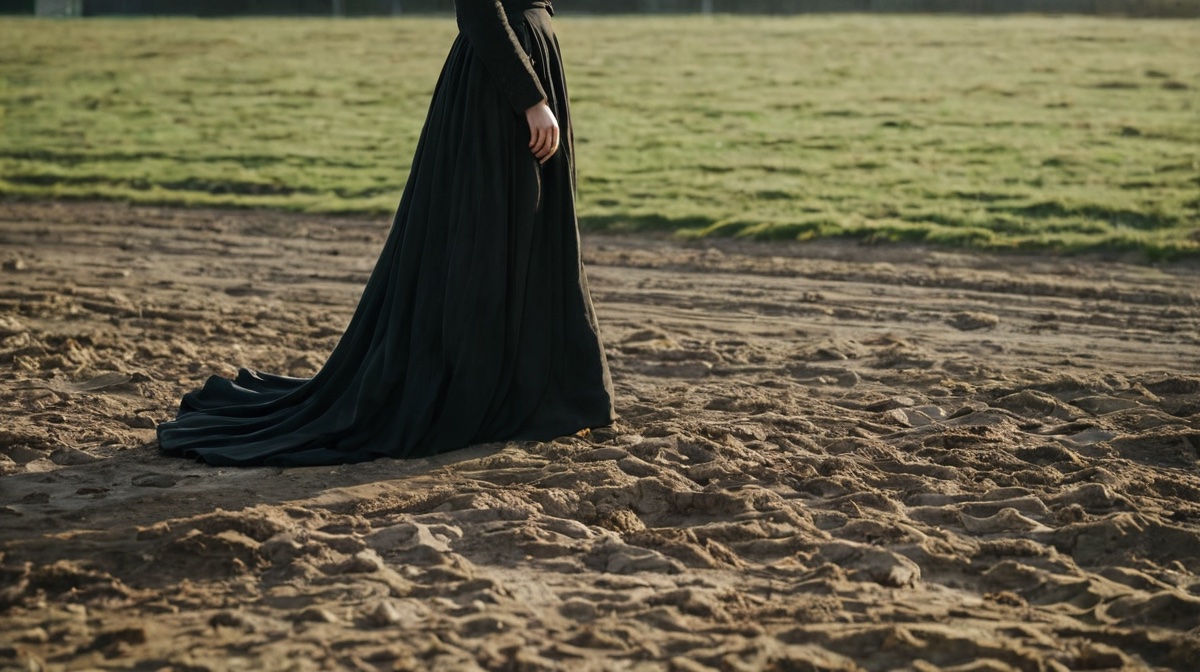
Light falls off quickly with distance, which is the most useful thing to know about backgrounds: moving a subject away from a wall darkens the wall for free.
Half a metre from the wall gives you a flat picture. Three metres from the same wall, with nothing else changed, gives you a figure standing out against a much darker ground. It is a stronger effect than most photographers expect and it costs nothing.
A longer lens compounds it, because a narrow angle of view takes in less of what is behind the subject. Between distance and focal length, an untidy room can be reduced to a small manageable patch that can then simply be excluded by moving the camera sideways. The trade is that both require floor space, which most rooms do not have to spare.
Depth of field is the weakest of the tools and the one reached for first. A blurred sofa is still a sofa, still bright, still rectangular, and still competing.
When a real room is right
There is a defensible argument for the domestic setting, and it is not about convenience.
A cleared studio makes a picture that could have been made anywhere at any time. That is the timeless claim, and it suits work that wants to be about form. A real room makes a picture about a specific evening in a specific place, and that claim is not available in a studio at any price.
The postwar magazine photographs are almost entirely of the second kind, because they were made by readers in their own homes with the lamp they owned. A great deal of their directness comes from that, and the look of the whole period was shaped by those conditions.
If a real room is the choice, it still has to be edited. The difference between a room picture and a mess picture is that the room picture kept exactly one thing on purpose: a window, a mat, a shoji screen, a single lamp. One retained element reads as a decision. Six read as the room.
The single deliberate object

Plain ground with one thing in it is the most efficient background this genre has.
A lantern at the edge of the frame. A folded cloth. A low table. The object does three jobs: it gives scale, it justifies the light coming from where it comes from, and it places the picture in a world without describing that world. The study lantern and shoulder is built on precisely that arrangement, with a paper lantern at the left edge doing all the work that an entire set would otherwise have to do.
Choosing that object is a wardrobe and props decision as much as a set decision, and it should be made with the same care as everything the figure is wearing, which is the subject of wardrobe and drapery.
Check the frame, not the room
One last habit is worth building: stop assessing the setup by looking at the room, and start assessing it by looking through the camera.
The eye edits constantly and forgivingly. It knows the coat on the chair is not part of the scene, so it stops registering it. The camera has no such filter, records everything at equal weight, and hands you a rectangle in which the coat is the second most prominent object.
Frame the empty scene before anyone is in it, look at that rectangle carefully, and remove what is in it. Whatever is left will be in the picture, and it will be there because somebody decided it should be.
Questions readers ask
What is the best background for rope photography?
Whatever differs from the rope in brightness and contains nothing that competes for attention. That can be a mid grey wall, a dark ground with a rim light picking out the edges of the figure, or a real room stripped of everything except one deliberate element. Colour matters much less than tonal separation and much less than emptiness.
Is a paper backdrop better than a real room?
Not automatically, and often worse. Paper gives you control and takes away specificity, so a paper picture has to earn its interest entirely from the figure and the light. A real room supplies texture, a sense of place and a plausible reason for the light to be coming from where it is. The condition is that the room has to be cleared, and clearing a room properly takes longer than putting up paper.
How do you stop a background from being distracting?
Remove it, darken it, or get further from it. Removing means physically taking objects out of shot, which is the most reliable and least popular option. Darkening means keeping light off it, which distance does for free because light falls away quickly. Getting further from it also compresses what a longer lens sees behind the subject. Blurring it is the weakest of the four and the one most people try first.
A shoot is three people and a lot of talking
Technique is the cheap part of an image like this. The collaborators are the expensive part, and they are found in rooms, not in tutorials.
Find the people