Study
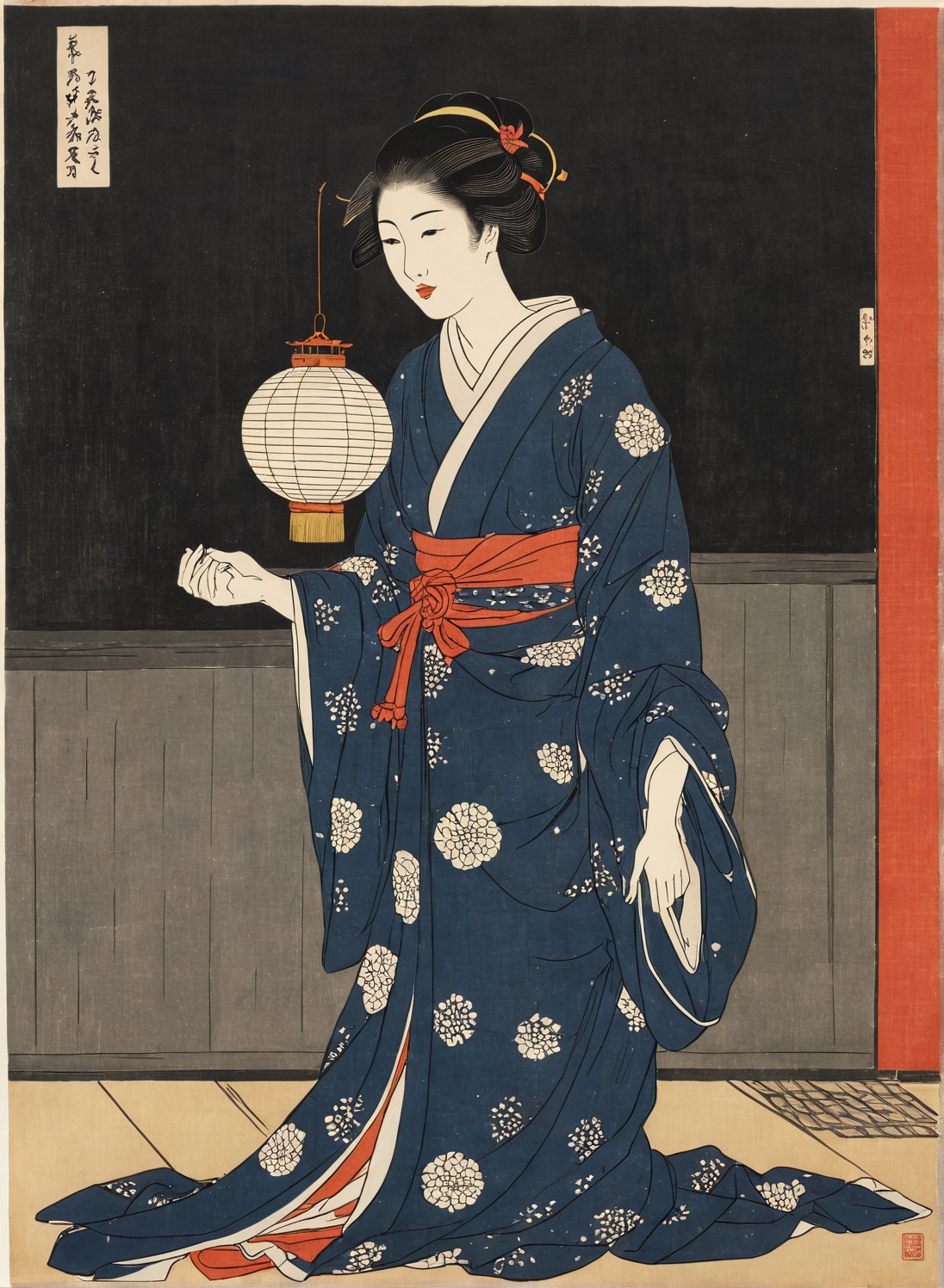
Lantern and shoulder Ukiyo-e woodblock manner
A paper lantern at the left edge lays flat warm colour across one shoulder while the rest of the figure stays in unmodelled shade.
Lantern and shoulder
Note by Tomas Berg, Rope photographer Mounted 21 August 2026
This one borrows the logic of the woodblock print, which means it has to solve its problem without modelling.
A paper lantern sits at the extreme left, cropped so only two thirds of it are present. Its light falls across a single bare shoulder and the upper arm below it, laid down as one flat warm field with a hard boundary rather than as a gradient. Where the light stops it simply stops. The rest of the figure, robed in dark patterned cotton, is a second flat field with no interior shading at all.
Line carries the description. Every edge is drawn: the contour of the shoulder, the folds of the robe, the turns of pale rope crossing the upper arm. The rope is left almost uncoloured, so it registers as light shapes against the dark robe and as drawn outlines against the lit skin. It changes role depending on which field it crosses, which is what the study set out to test.
The composition is stacked rather than receding. Lantern at the left, figure filling the centre and right, plain ground above, no floor and no horizon. The head is turned away and cropped at the top of the frame, which removes the question of expression and leaves the shoulder as the subject.
The result is a picture with no chiaroscuro and no depth doing any work, where a viewer still reads weight and direction. Print conventions manage that with contour alone. It mostly survives the translation.
The plates on this site are original studies made for it. They are worked in the manner of a tradition rather than taken from one: they are not historical works, they reproduce no existing picture, and they are attributed to no artist. Where a study is described as after sumi-e, after a woodblock print or after a modern photograph, that names the look the image imitates, not the hand or the century that made it.
Someone held that position
Nobody held this position for the plate. In the kind of picture it imitates, somebody always did.
Find the people