Lineage
How kinbaku reached the west
By Yuki Almeida, Tradition and aesthetics Published 9 September 2026
Western audiences met kinbaku late, mostly from the 1990s onward, and through three channels that each delivered a different image of it. Books arrived first and taught the west to see rope as a catalogue of finished shapes, because a printed manual has to show the completed pose. Touring teachers and performers arrived next and reintroduced duration, which a still photograph cannot carry. The internet arrived last and removed the editor, which multiplied the volume of rope imagery and detached most of it from any account of who made it or why.
This site writes about rope as an image, and it publishes no tying instructions: no steps, no named ties given as method, nothing to follow. Rope on a body carries real physical risk, and anyone who wants to learn it should learn in person, slowly, from experienced teachers.
Kinbaku arrived in the west as pictures before it arrived as practice, and the order matters. By the time anyone outside Japan could watch it happen in a room, several thousand people had already formed an idea of what it should look like from printed and screen images. Practice then had to catch up with a picture rather than the other way round.
The book taught the west to see a finished pose
Midori’s The Seductive Art of Japanese Bondage came out from Greenery Press in 2001 and is generally described as the first English instructional book on the subject. Its design is the interesting part. Each chapter opens with a full colour photograph of the completed arrangement, taken by Craig Morey, and the explanation of how it was reached follows underneath.
That is a sensible way to build a manual and it had a side effect that outlasted the manual. A book of finished poses teaches a reader that the finished pose is the object. The picture at the head of the chapter is the goal, the pages after it are the route, and the implicit lesson is that a rope image records an achievement.
Almost nothing in the Japanese material that preceded it works that way. The magazine photographs of the postwar decades are frequently mid process, off centre, and interested in a face or a hand rather than in the completeness of an arrangement. The magazines that made a scene is full of pictures that would make no sense as the frontispiece to a chapter, because they are not demonstrating anything.
Master K’s The Beauty of Kinbaku arrived in 2008 and took the other route: 194 illustrated pages in black and white, concerned with origins and history rather than instruction. It was translated into Japanese in 2013 and carried an endorsement from Nureki Chimuo, which is a notable direction of travel for a book written in English by a westerner.
Then people turned up who could not be photographed
Teaching and performance arrived through individuals travelling, and the documented careers are useful because they are specific rather than atmospheric.
Osada Steve is one. He met Osada Eikichi in 1998 during a photoshoot, assisted at his teacher’s stage performances, studied with him until Eikichi retired in 2001, and then continued the shows under his own name. He taught in Berlin, ran workshops and demonstrations across Europe including a tour in 2006, and being a native German speaker he could teach Europeans in a language they had. He is also credited with making the introduction that took Hajime Kinoko to a London festival for his first western performance. Kinoko had learned in Tokyo under practitioners including Haruki Yukimura, Kanna and Akechi Denki.
What a living performance restores is duration. A rope piece takes time, most of that time is unphotographable, and the parts a camera likes are a small and unrepresentative sample. An audience watching a performance learns something about pace and attention that no book of plates conveys, which is why the touring years changed western practice more than the publishing years did, even though far fewer people were in the room.
The internet removed the editor
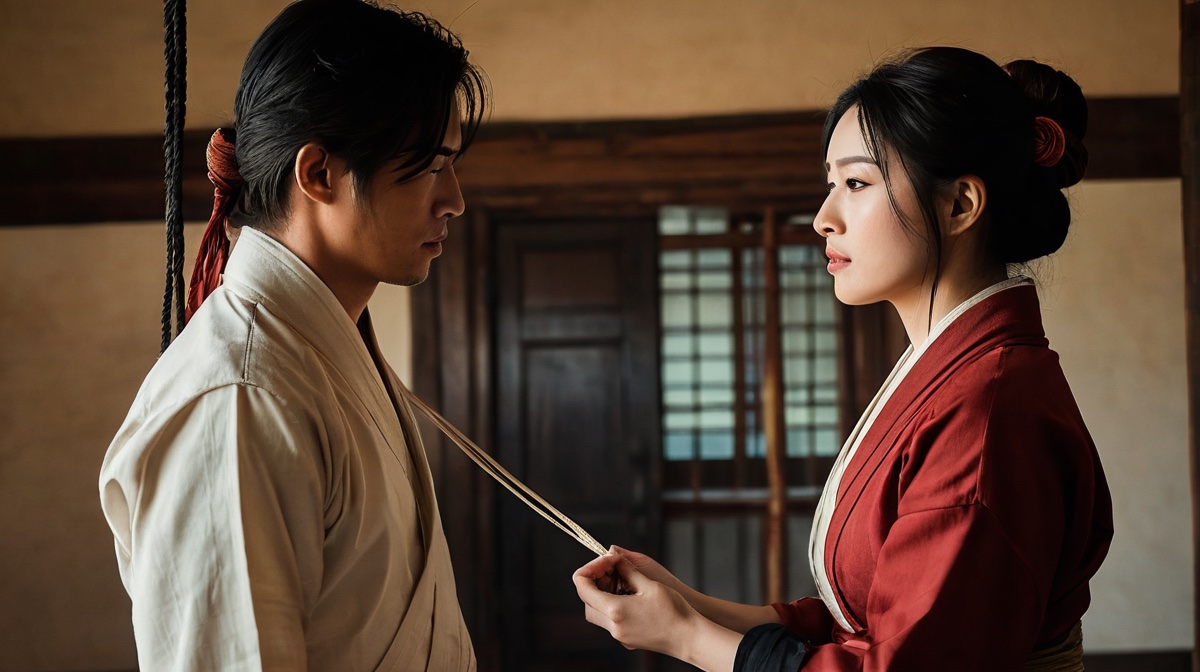
The third channel had no gatekeeper. Where the Japanese magazines had an editor deciding what went in the issue, an image board has an upload button, and the volume of rope imagery available in English went from a handful of imported books to effectively unlimited inside about a decade.
Two things followed. The first is good: practitioners could see far more work, including work from Japan, without needing an importer or a translator. The second is not. An image posted without an account of who made it, with whom, and under what agreement is an image stripped of everything except its shape, and shape is the least informative thing about a rope photograph. A great deal of what circulated in that period is a copy of a copy of a silhouette.
The current generation of photographers has been pushing back against exactly this, and the generation working now covers how they do it: naming collaborators in the caption, agreeing terms in writing, and publishing in places where a picture can carry its context with it.
Two words, one confusion
English settled on shibari as its everyday term. In Japanese, shibari is a plain word for tying and kinbaku points more specifically at the erotic practice, so the western preference is a slight mistranslation that has now been in circulation long enough to be simply what the word means in English.
It is a small thing with one real consequence. Because shibari sounds technical and neutral, English-language writing about it tends to become technical and neutral too, describing arrangements rather than pictures. Some of the flatness of western commentary on this subject comes from having chosen the more clinical of two available words.
What actually crossed
Set the channels side by side and the pattern is consistent. Everything that survives a still image travelled well: the shapes, the compositional habits, the preference for a legible line, the high contrast look that was itself half an accident of cheap paper. Everything that exists only in time travelled badly.
That is not a complaint about western practitioners, who could hardly have imported the parts nobody photographed. It is a description of a filter. Any tradition transmitted mainly through images will arrive with its temporal dimension missing, and the receiving culture will spend the next twenty years working out what is missing and reconstructing it from scratch.
The reconstruction has mostly happened. What remains visible in a lot of western rope photography is the original bias: an image that treats the arrangement as the subject and the person in it as the surface it is applied to. That is a reading problem as much as a making problem, and how to look at a rope photograph sets out the alternative.
Questions readers ask
What was the first English language book on shibari?
Midori's The Seductive Art of Japanese Bondage, published by Greenery Press in 2001, is generally named as the first English instructional book on the subject. Its structure is worth noting for anyone interested in how the west learned to see this material: each chapter opens with a full colour photograph of a finished pose, photographed by Craig Morey, and the explanation follows. Master K's The Beauty of Kinbaku followed in 2008 and took the historical rather than the instructional route.
Who brought kinbaku performance to western stages?
Touring practitioners, from the late 1990s onward. Osada Steve is a documented example: he met Osada Eikichi in 1998 at a photoshoot, worked with him until his teacher's retirement in 2001, continued the performances under his own name, and taught extensively in Europe, including a European tour in 2006. He is also credited with the introduction that led to Hajime Kinoko's first performance in the west, at a London festival.
Did anything get lost in transmission?
Context, mostly. What travelled well was the shape of a tie and the look of a finished picture, because both survive a photograph. What travelled badly was everything that only exists in time: the pace of a session, the relationship between the people in it, the difference between a pose held for the camera and a pose arrived at. A lot of western rope photography of the 2000s is a competent reproduction of a silhouette with none of that underneath it.
History is a record of people who met
Every tradition on this page was carried by practitioners who found each other, argued, and worked. Reading about it is the smaller half.
Find the people