Reading a tie
How to look at a rope photograph
By Yuki Almeida, Tradition and aesthetics Published 21 August 2026
Read a rope photograph in four passes. First find the line carrying the load, because it is the picture's structure and everything else is arranged around it. Second, follow where that line delivers your eye, which is the photographer's actual argument. Third, decide whether the image resolves on the arrangement or on the person, since those are two different kinds of picture and confusing them causes most bad criticism of the genre. Fourth, look at the edges and ask what was excluded, which is usually where the intent is clearest.
This site writes about rope as an image, and it publishes no tying instructions: no steps, no named ties given as method, nothing to follow. Rope on a body carries real physical risk, and anyone who wants to learn it should learn in person, slowly, from experienced teachers.
Most people look at a rope photograph the way they look at a magic trick: they try to work out how it was done. That is a reasonable first impulse and it is a dead end, because how it was done is a question about rope and the picture is not made of rope. It is made of light, arrangement and exclusion, and it can be read in a fixed order.
First pass: find the load
Somewhere in the frame, one line is taking the weight. It is usually the straightest thing in the picture, because tension pulls a curve out of a line, and it usually runs at an angle to the frame edges rather than parallel with them.
Find it and the composition becomes legible immediately. The angle of that line sets the picture’s direction. The body is positioned in response to it: a shoulder pulled up, a spine curved away, a hip carrying the remainder. Everything else in the arrangement is decoration hanging off that one structural fact.
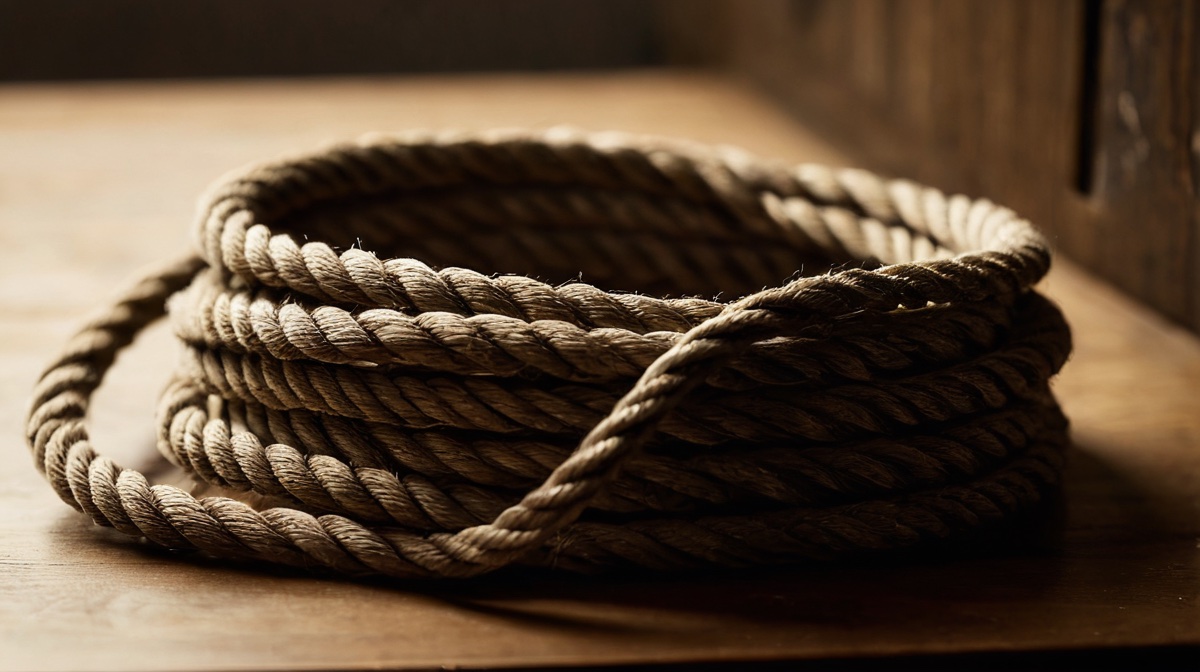
Sometimes there is no load line. That is worth noticing rather than treating as a failure. A picture of rope lying on a body without tension in it is a picture about texture and contact, not about force, and it should be read as a still life with a person in it. The plate rope at rest removes the body entirely to test how much of the effect survives, and rather more of it survives than most people expect.
Second pass: follow where it sends you
Now trace the line and see where it delivers you. This is the photographer’s actual argument, and it is far more informative than anything they might say about the picture afterwards.
Rope is unusually good at directing attention because it is literally a drawn line inside a photograph. A painter has to imply a vector. A rope photographer has a real one, physically present, with a start and an end. Where it ends is a decision.
Common destinations, and what each implies. To a face: the picture is a portrait and the rope is context. To a hand, particularly a hand that is relaxed or half open: the picture is about consent or about self possession, and it is usually the most sophisticated version of this genre. To a junction where several lines cross: the picture is about the arrangement. Out of the frame entirely: the picture is about a force coming from somewhere the viewer cannot see, which is a much older compositional device than kinbaku and is where the tradition’s theatrical inheritance shows most clearly.
Third pass: knot or person

Two kinds of picture get filed under the same heading and they are not the same object.
The first is a record of an arrangement. Its subject is the configuration, the body is the armature the configuration is built on, and the person’s identity is incidental. These pictures are judged like technical drawings: clarity, legibility, whether the structure can be read. They are frequently useful and frequently dull, and there is nothing wrong with them provided nobody mistakes them for the other kind.
The second is a picture of a person who happens to be in rope. Its subject is a state, an expression, a way of carrying weight. The arrangement is the instrument, and it can be simple to the point of crudeness as long as it produces the thing the picture is about. Judged as a technical record it will often look poor. Judged as a portrait it can be extraordinary.
Most criticism of rope photography goes wrong here. Someone applies the first standard to the second kind of picture and complains that the arrangement is basic, or applies the second standard to the first kind and complains that it is cold. Deciding which object you are holding is most of the work of looking at one.
Fourth pass: read the edges
Every rope photograph is a severe edit. The room it was made in contained equipment, bags, a chair, someone’s coat, at least one other person and probably a phone. All of it was removed, and the removals are the most deliberate decisions in the picture.
A frame stripped to a figure and a plain ground is claiming that this could have happened at any point in the last century. It is a claim about timelessness, and it is usually the claim being made when a picture reaches for the tradition. A frame that keeps a radiator, a skirting board or the edge of a mattress is claiming the opposite: a specific evening, in a real flat, with these particular people. Neither is more honest. They are different pictures.
Then look at what the crop did to the body. A frame that cuts the head off is making a decision about identity and it is not a neutral one. A frame that keeps the feet in is usually more interested in weight and balance than in the face. A frame with a great deal of empty space above the figure has hung the picture on a vertical, and the emptiness is doing structural work rather than sitting there.
What not to bother with
Two habits waste time.
Trying to identify the arrangement by name tells you nothing about the picture. Two photographs of the same configuration can be entirely different objects, and knowing the name of a shape is knowledge about rope, not about images. This site is not about rope in that sense.
Reading the model’s expression as a report on their internal state is also unreliable. What a photograph records is a face at one four-hundredth of a second, selected from several hundred alternatives by somebody with an intention. It tells you what the picture wanted. It does not tell you what the day was like, and the gap between those two things is the subject of whose picture is it.
Doing it quickly
With practice the four passes collapse into a couple of seconds. Load line, direction, subject, edges. It is a diagnostic rather than a verdict, and it will not tell you whether a picture is good.
What it does is stop you being impressed by the wrong thing. A great deal of rope photography is technically dense and compositionally empty, and complexity reads as skill until you have a way of asking what the complexity is for. Ask where the weight is and where the eye ends up, and a startling number of impressive pictures turn out to have no answer.
There is a fifth question available once the four are habitual, and it is the one that decides most arguments about this genre: does the picture finish, or does it leave something outstanding. That distinction, and how much of it survives contact with the institutions that hand out the labels, is the subject of art or pornography, and who decides.
Questions readers ask
What should I look at first in a rope image?
The line that is taking the weight. Every competent rope photograph has one, and finding it tells you how the frame is organised, because everything else in the composition is positioned relative to it. If you cannot find one, that is diagnostic too: either the picture is about something other than tension, or it is a record of an arrangement rather than a composition.
How can you tell whether a picture is about the tie or about the person?
Ask where your eye stops. If it settles on a crossing, a junction or a pattern and stays there, the picture is about the arrangement, and the body is the surface it is applied to. If it travels along the rope and ends on a face, a hand or the set of the shoulders, the picture is about the person and the rope is the instrument that got you there. Both are legitimate. They are judged by different standards.
Does it matter what is outside the frame?
It matters more than most of what is inside it. Every rope photograph is a heavy edit of a room containing equipment, other people, clothing and mess, and the choice of what to exclude is the most deliberate decision in the picture. A frame that removes all context is making a claim about timelessness. One that leaves a doorway or a corner of furniture visible is making a different claim, about a real evening in a real place.
History is a record of people who met
Every tradition on this page was carried by practitioners who found each other, argued, and worked. Reading about it is the smaller half.
Find the people