Aesthetics
Art or pornography, and who decides
By Yuki Almeida, Tradition and aesthetics Published 4 September 2026
The usual test, that art is tasteful and pornography is explicit, does not survive contact with either category. A more useful distinction is about what the picture is organised to do. A pornographic image is built to be sufficient in itself and to resolve, which is why it shows the peak and leaves nothing outstanding. An art image is built to remain unresolved, and depends on a viewer bringing something to it. That is a real formal difference and it is visible in the frame. It is also true that in practice the category is assigned by institutions rather than by the picture, and any honest answer has to say so.
This site writes about rope as an image, and it publishes no tying instructions: no steps, no named ties given as method, nothing to follow. Rope on a body carries real physical risk, and anyone who wants to learn it should learn in person, slowly, from experienced teachers.
The question comes up in every conversation about this subject and it is nearly always answered with a gesture at lighting. Good light, careful composition and no visible genitals, therefore art. It is a bad test, and the people using it usually know that.
The usual test fails in both directions
Take the tasteful criterion seriously for a moment and see where it goes. It would classify a large volume of stock photography as art, since stock photography is nothing if not tasteful. It would exclude a good deal of work that hangs in museums, which is frequently coarse, badly lit on purpose, and explicit. It would make the category depend on wardrobe.
Run it the other way and it is no better. If explicitness is what disqualifies a picture, then a substantial part of the history of European painting is in trouble, and so is most photography made about the body since the 1960s.
What the taste test actually measures is class and production budget. A picture made with a stylist, a location and a retoucher looks like the pictures found in galleries, because those are the conditions under which gallery pictures are made. That is a fact about economics wearing the costume of an aesthetic judgement.
A distinction that is actually in the frame
There is a real formal difference between the two kinds of image, and it has nothing to do with how much skin is showing.
A pornographic image is built to be sufficient. It answers its own question inside the frame, shows the thing at its peak, and needs no context, no caption and no second look. Efficiency is the design goal, and it is a genuine skill. The image is complete on arrival and the viewer’s work is finished.
An image with artistic ambition is built to be insufficient. Something is withheld: the moment before or after rather than the moment, a face turned away, a gesture whose meaning is unclear, an arrangement whose purpose is not stated. The viewer has to supply the missing part, and supplying it is the experience. This is the preference what makes a rope image beautiful describes as the moment beside the moment, and it is not a moral preference. It is a design decision about where the work happens.
Judged this way, a fully clothed picture can be pornographic, in the precise sense that it resolves and asks nothing. A great deal of polite rope photography is exactly that: an efficient delivery of a recognisable shape, complete on arrival, with the sheen of seriousness applied afterwards in the edit.
Intent is not visible and does not help
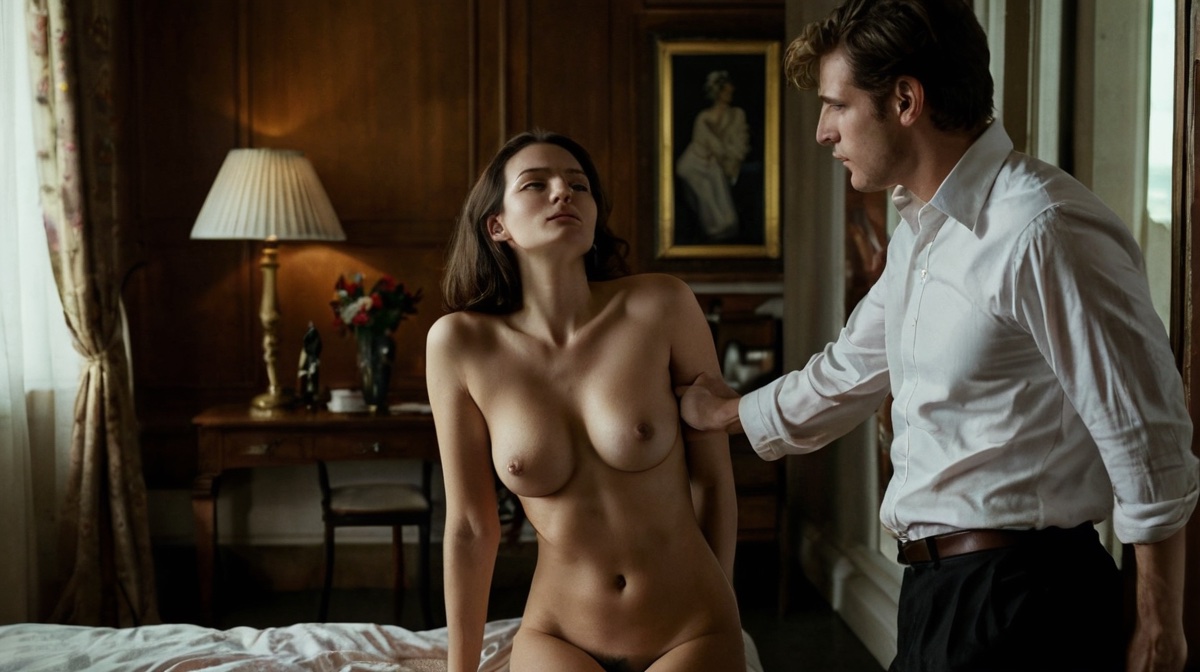
A common move at this point is to say the difference is intent: art is made to be contemplated, pornography to arouse. The trouble is that intent is invisible, unverifiable and frequently mixed. Photographers are not obliged to know why they made something, and the ones who claim to know are not always right.
Worse, the intent test lets any picture be reclassified by assertion. Say the word contemplation and the category changes without a pixel moving. Formal properties are at least available for inspection. Whether a picture resolves or withholds is something two people can look at and disagree about with reference to what is actually there.
Arousal is not a disqualifier in any case. Plenty of work that is unambiguously art is designed to affect the body, and pretending otherwise is a squeamishness that this subject in particular cannot afford.
The institutional answer, stated plainly
Here is the part usually left out. In practice the category is not decided by the picture. It is decided by where the picture ends up.
A photograph published in a magazine sold in a plastic wrapper is pornography. The same photograph in a gallery with a wall label is art. The same photograph in a monograph from a serious publisher, with an essay in the back, is art with a bibliography. Nothing in the image changed. What changed was the apparatus around it: who selected it, who wrote about it, what it costs, and who can be seen looking at it without embarrassment.
That apparatus is not neutral. It responds to reputation, nationality, gender and money, and it has historically been more willing to grant the art label to men, to foreigners working in an exotic tradition, and to anyone with a dealer. The Japanese photographer whose rope work is held in major collections and the anonymous contributor whose photograph ran in a 1961 magazine were doing formally similar things under wildly different conditions, and only one of them got a category upgrade. The magazines that made a scene is largely the story of the second group.
Why the question is still worth asking
None of this means the distinction is empty. It means it is doing two jobs at once and they should be separated.
As a formal question, art or pornography is a useful thing to ask of a single picture. Does it resolve or does it withhold? Is the viewer’s attention finished when they have identified what is happening, or does something remain? That question has an answer you can point at, and asking it improves the pictures you make.
As a social question, it is mostly about permission. It asks whether it is acceptable to take this seriously in public, and the honest answer is that acceptability is granted by institutions with their own history, not by the work. Knowing that stops you mistaking a gallery’s approval for a verdict on quality, in either direction.
The place this becomes concrete is the career of a photographer who has been assigned both labels at different times, which is the situation described in Nobuyoshi Araki, read from the public record. The formal question and the institutional one pull in opposite directions there, and the disagreement is more instructive than any settlement of it would be.
Questions readers ask
Is kinbaku photography art or pornography?
Both categories contain a great deal of it and the boundary is not drawn by subject matter. A photograph of a bound figure can be organised to resolve completely, which is how pornographic images work, or organised to withhold, which is how most art images work. The same practitioners produce both, often in the same session. The question is more useful when asked of a particular picture than of the genre.
Does being non-explicit make an image art?
No. Restraint of that kind is a convention of the gallery, not a property of the work, and a great deal of very dull commercial photography is entirely non-explicit. Explicitness and formal ambition are independent variables. Plenty of explicit work is formally serious and plenty of coy work is empty. Using clothedness as a proxy for artistic seriousness mostly filters for who could afford a stylist.
Who actually decides which category a picture is in?
Institutions, in practice. Where a picture is published, who wrote about it, whether it entered a collection, whether it was sold as a print or as a page. Those decisions are made by galleries, editors, curators and courts, and they are influenced by the maker's reputation and nationality as much as by the image. This is not a reason to abandon the distinction, but it is a reason to be suspicious when someone claims the picture settles it on its own.
History is a record of people who met
Every tradition on this page was carried by practitioners who found each other, argued, and worked. Reading about it is the smaller half.
Find the people