Study
Rope at rest Modern still life photograph
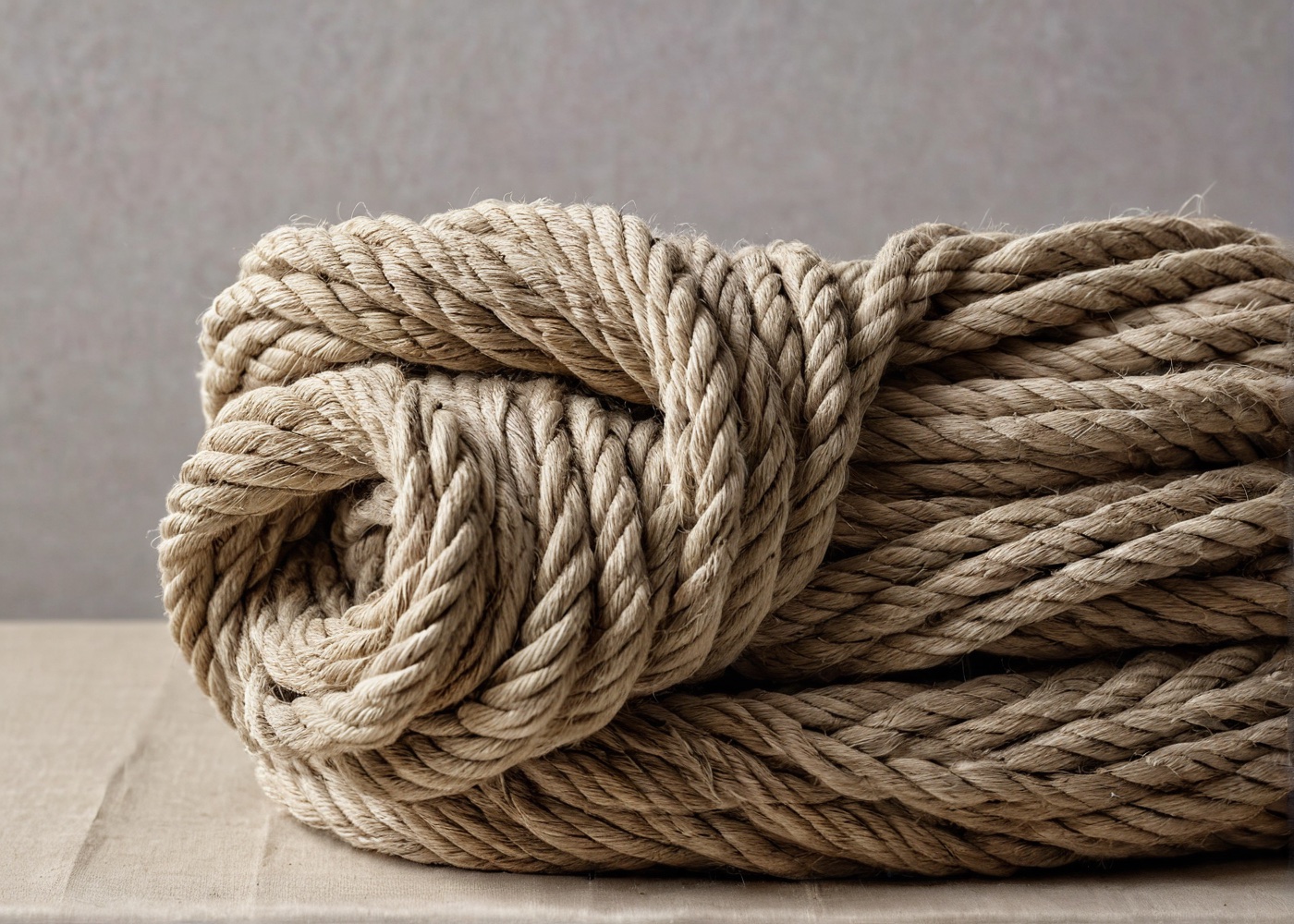
A coil of jute lies on folded cloth with no one in the frame, raked from the left so the twist reads along its length.
Rope at rest
Note by Tomas Berg, Rope photographer Mounted 24 August 2026
The premise is subtraction. Take the figure out and see what the picture still has.
A single coil of jute lies slightly off centre on a folded length of undyed cotton, on a plain surface, against a background of even mid grey. The coil is loose rather than neatly wound. Two ends escape it, one running toward the lower right corner and leaving the frame, the other doubled back across the body of the coil. That doubled end is the only crossing in the picture and it is where the eye ends up.
The light rakes in from the left, close to the plane of the table, and it is hard enough to keep its edges. Every turn of the twist throws a small shadow, so the spiral is legible along the whole length rather than only at the highlights. The cloth beneath takes the same light differently, catching it broadly across the folds, and the two materials separate on texture alone with barely any difference in colour between them.
The background is a full stop brighter than the rope and carries no detail, so nothing competes. There is no cast shadow of consequence, which keeps the arrangement floating and stops it becoming a picture of a table.
What survives the subtraction is more than expected. The coil holds the shape of something recently used, the escaped ends imply direction, and the object reads as an aftermath. The lighting decisions are the ones set out in lighting rope for photography, tested on the simplest possible subject.
The plates on this site are original studies made for it. They are worked in the manner of a tradition rather than taken from one: they are not historical works, they reproduce no existing picture, and they are attributed to no artist. Where a study is described as after sumi-e, after a woodblock print or after a modern photograph, that names the look the image imitates, not the hand or the century that made it.
Someone held that position
Nobody held this position for the plate. In the kind of picture it imitates, somebody always did.
Find the people